 F# for Fun and Profit
Four Key Concepts
In the next few posts we’ll move on to demonstrating the themes of this series: conciseness, convenience, correctness, concurrency and completeness.
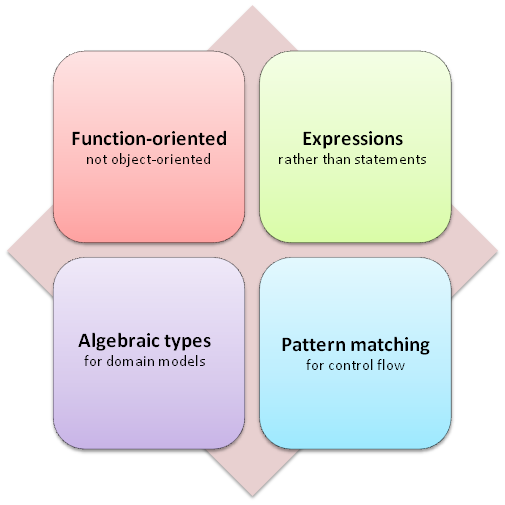
But before that, let’s look at some of the key concepts in F# that we will meet over and over again. F# is different in many ways from a standard imperative language like C#, but there are a few major differences that are particularly important to understand:
- Function-oriented rather than object-oriented
- Expressions rather than statements
- Algebraic types for creating domain models
- Pattern matching for flow of control
In later posts, these will be dealt with in much greater depth – this is just a taster to help you understand the rest of this series.
As you might expect from the term “functional programming”, functions are everywhere in F#.
Of course, functions are first class entities, and can be passed around like any other value:
let square x = x * x

// functions as values
let squareclone = square
let result = [1..10] |> List.map squareclone

// functions taking other functions as parameters
let execFunction aFunc aParam = aFunc aParam
let result2 = execFunction square 12
But C# has first-class functions too, so what’s so special about functional programming?
The short answer is that the function-oriented nature of F# infiltrates every part of the language and type system in a way that it does not in C#, so that things that are awkward or clumsy in C# are very elegant in F#.
It’s hard to explain this in a few paragraphs, but here are some of the benefits that we will see demonstrated over this series of posts:
- Building with composition. Composition is the ‘glue’ that allows us build larger systems from smaller ones. This is not an optional technique, but is at the very heart of the functional style. Almost every line of code is a composable expression (see below). Composition is used to build basic functions, and then functions that use those functions, and so on. And the composition principle doesn’t just apply to functions, but also to types (the product and sum types discussed below).
- Factoring and refactoring. The ability to factor a problem into parts depends how easily the parts can be glued back together. Methods and classes that might seem to be indivisible in an imperative language can often be broken down into surprisingly small pieces in a functional design. These fine-grained components typically consist of (a) a few very general functions that take other functions as parameters, and (b) other helper functions that specialize the general case for a particular data structure or application. Once factored out, the generalized functions allow many additional operations to be programmed very easily without having to write new code. You can see a good example of a general function like this (the fold function) in the post on extracting duplicate code from loops.
- Good design. Many of the principles of good design, such as “separation of concerns”, “single responsibility principle”, “program to an interface, not an implementation”, arise naturally as a result of a functional approach. And functional code tends to be high level and declarative in general.
The following posts in this series will have examples of how functions can make code more concise and convenient, and then for a deeper understanding, there is a whole series on thinking functionally.
In functional languages, there are no statements, only expressions. That is, every chunk of code always returns a value, and larger chunks are created by combining smaller chunks using composition rather than a serialized list of statements.
If you have used LINQ or SQL you will already be familiar with expression-based languages. For example, in pure SQL, you cannot have assignments. Instead, you must have subqueries within larger queries.
SELECT EmployeeName
FROM Employees
WHERE EmployeeID IN
	(SELECT DISTINCT ManagerID FROM Employees)  -- subquery
F# works in the same way – every function definition is a single expression, not a set of statements.
And it might not be obvious, but code built from expressions is both safer and more compact than using statements. To see this, let’s compare some statement-based code in C# with the equivalent expression-based code.
First, the statement-based code. Statements don’t return values, so you have to use temporary variables that are assigned to from within statement bodies.
// statement-based code in C#
int result;
if (aBool)
{
  result = 42;
}
Console.WriteLine("result={0}", result);
Because the if-then block is a statement, the result variable must be defined outside the statement but assigned to from inside the statement, which leads to issues such as:
- What initial value should
resultbe set to? - What if I forget to assign to the
resultvariable? - What is the value of the
resultvariable in the “else” case?
For comparison, here is the same code, rewritten in an expression-oriented style:
// expression-based code in C#
int result = (aBool) ? 42 : 0;
Console.WriteLine("result={0}", result);
In the expression-oriented version, none of these issues apply:
- The
resultvariable is declared at the same time that it is assigned. No variables have to be set up “outside” the expression and there is no worry about what initial value they should be set to. - The “else” is explicitly handled. There is no chance of forgetting to do an assignment in one of the branches.
- It is not possible to forget to assign
result, because then the variable would not even exist!
Expression-oriented style is not a choice in F#, and it is one of the things that requires a change of approach when coming from an imperative background.
The type system in F# is based on the concept of algebraic types. That is, new compound types are built by combining existing types in two different ways:
- First, a combination of values, each picked from a set of types. These are called “product” types.
- Or, alternately, as a disjoint union representing a choice between a set of types. These are called “sum” types.
For example, given existing types int and bool, we can create a new product type that must have one of each:
//declare it
type IntAndBool = {intPart: int; boolPart: bool}

//use it
let x = {intPart=1; boolPart=false}
Alternatively, we can create a new union/sum type that has a choice between each type:
//declare it
type IntOrBool =
  | IntChoice of int
  | BoolChoice of bool

//use it
let y = IntChoice 42
let z = BoolChoice true
These “choice” types are not available in C#, but are incredibly useful for modeling many real-world cases, such as states in a state machine (which is a surprisingly common theme in many domains).
And by combining “product” and “sum” types in this way, it is easy to create a rich set of types that accurately models any business domain. For examples of this in action, see the posts on low overhead type definitions and using the type system to ensure correct code.
Most imperative languages offer a variety of control flow statements for branching and looping:
if-then-else(and the ternary versionbool ? if-true : if-false)caseorswitchstatementsforandforeachloops, withbreakandcontinuewhileanduntilloops- and even the dreaded
goto
F# does support some of these, but F# also supports the most general form of conditional expression, which is pattern-matching.
A typical matching expression that replaces if-then-else looks like this:
match booleanExpression with
| true -> // true branch
| false -> // false branch
And the replacement of switch might look like this:
match aDigit with
| 1 -> // Case when digit=1
| 2 -> // Case when digit=2
| _ -> // Case otherwise
Finally, loops are generally done using recursion, and typically look something like this:
match aList with
| [] ->
     // Empty case
| first::rest ->
     // Case with at least one element.
     // Process first element, and then call
     // recursively with the rest of the list
Although the match expression seems unnecessarily complicated at first, you’ll see that in practice it is both elegant and powerful.
For the benefits of pattern matching, see the post on exhaustive pattern matching, and for a worked example that uses pattern matching heavily, see the roman numerals example.
We mentioned above that F# supports a “union” or “choice” type. This is used instead of inheritance to work with different variants of an underlying type. Pattern matching works seamlessly with these types to create a flow of control for each choice.
In the following example, we create a Shape type representing four different shapes and then define a draw function with different behavior for each kind of shape.
This is similar to polymorphism in an object oriented language, but based on functions.
type Shape =        // define a "union" of alternative structures
    | Circle of radius:int
    | Rectangle of height:int * width:int
    | Point of x:int * y:int
    | Polygon of pointList:(int * int) list

let draw shape =    // define a function "draw" with a shape param
  match shape with
  | Circle radius ->
      printfn "The circle has a radius of %d" radius
  | Rectangle (height,width) ->
      printfn "The rectangle is %d high by %d wide" height width
  | Polygon points ->
      printfn "The polygon is made of these points %A" points
  | _ -> printfn "I don't recognize this shape"

let circle = Circle(10)
let rect = Rectangle(4,5)
let point = Point(2,3)
let polygon = Polygon( [(1,1); (2,2); (3,3)])

[circle; rect; polygon; point] |> List.iter draw
A few things to note:
- As usual, we didn’t have to specify any types. The compiler correctly determined that the shape parameter for the “draw” function was of type
Shape. - The
int * intin the definition of thePolygoncase is a tuple, a pair of ints. If you’re wondering why the types are “multiplied”, see this post on tuples. - You can see that the
match..withlogic not only matches against the internal structure of the shape, but also assigns values based on what is appropriate for the shape. - The underscore is similar to the “default” branch in a switch statement, except that in F# it is required – every possible case must always be handled. If you comment out the line
| _ -> printfn "I don't recognize this shape"
see what happens when you compile!
These kinds of choice types can be simulated somewhat in C# by using subclasses or interfaces, but there is no built in support in the C# type system for this kind of exhaustive matching with error checking.
You might be wondering if this kind of pattern matching is a good idea? In an object-oriented design, checking for a particular class is an anti-pattern because you should only care about behavior, not about the class that implements it.
But in a pure functional design there are no objects and no behavior. There are functions and there are “dumb” data types. Data types do not have any behavior associated with them, and functions do not contain data – they just transform data types into other data types.
In this case, Circle and Rectangle are not actually types. The only type is Shape – a choice, a discriminated union – and these are various cases of that type.
(More about discriminated unions here).
In order to work with the Shape type, a function needs to handle each case of the Shape, which it does with pattern matching.
The "Why use F#?" series
-
Introduction to the 'Why use F#' series
An overview of the benefits of F# -
F# syntax in 60 seconds
A very quick overview on how to read F# code -
Comparing F# with C#: A simple sum
In which we attempt to sum the squares from 1 to N without using a loop -
Comparing F# with C#: Sorting
In which we see that F# is more declarative than C#, and we are introduced to pattern matching. -
Comparing F# with C#: Downloading a web page
In which we see that F# excels at callbacks, and we are introduced to the 'use' keyword -
Four Key Concepts
The concepts that differentiate F# from a standard imperative language -
Conciseness
Why is conciseness important? -
Type inference
How to avoid getting distracted by complex type syntax -
Low overhead type definitions
No penalty for making new types -
Using functions to extract boilerplate code
The functional approach to the DRY principle -
Using functions as building blocks
Function composition and mini-languages make code more readable -
Pattern matching for conciseness
Pattern matching can match and bind in a single step -
Convenience
Features that reduce programming drudgery and boilerplate code -
Out-of-the-box behavior for types
Immutability and built-in equality with no coding -
Functions as interfaces
OO design patterns can be trivial when functions are used -
Partial Application
How to fix some of a function's parameters -
Active patterns
Dynamic patterns for powerful matching -
Correctness
How to write 'compile time unit tests' -
Immutability
Making your code predictable -
Exhaustive pattern matching
A powerful technique to ensure correctness -
Using the type system to ensure correct code
In F# the type system is your friend, not your enemy -
Worked example: Designing for correctness
How to make illegal states unrepresentable -
Concurrency
The next major revolution in how we write software? -
Asynchronous programming
Encapsulating a background task with the Async class -
Messages and Agents
Making it easier to think about concurrency -
Functional Reactive Programming
Turning events into streams -
Completeness
F# is part of the whole .NET ecosystem -
Seamless interoperation with .NET libraries
Some convenient features for working with .NET libraries -
Anything C# can do...
A whirlwind tour of object-oriented code in F# -
Why use F#: Conclusion
 Twitter